

09/26/2009
Professionals are moving towards substantial fair communication. Politicians are not yet.
I cannot be suspected of being complacent with professionals in Luxembourg.
I would like to underline a substantial change to their communication that deserves being congratulated.
In an interview last week, Jean Jacques Rommes said: "Je crois qu'il y a évidemment une sécurité, une confiance en nous-mêmes qui ont été ébranlées. Nous nous étions habitués, non seulement sur la place financière, mais dans l'économie luxembourgeoise en général, à des chiffres de croissance impressionnants, à des certitudes qui s'avèrent intenables à plus long terme. Je dois dire que, pour le principe, cela n'a pas tellement étonné l'ABBL. Sur le détail et sur la force de l'impact par contre oui. Nous avions toujours dit que les arbres n'allaient pas pousser jusqu'au ciel. Mais alors, que les racines les plus solides de la place financière se trouvent ébranlées comme cela, je vous avoue volontiers que je n'y aurais pas cru. Nous partageons à l'ABBL, le même ébranlement que doit ressentir l'homme de la rue, qui lui aussi s'était sans doute figuré que les choses seraient un peu plus solides que cela. Voilà pour l'impression. Ensuite, il y a les faits : Le fait que la place financière ne va plus générer à l'avenir les chiffres de croissance des dernières quinze années ; le fait que l'économie luxembourgeoise en général, ses budgets et les possibilités de l'État luxembourgeois devront s'adapter à cette donne ; le fait que la crise n'est pas terminée et que des impacts certains sur l'économie luxembourgeoise ne sont même pas encore ressentis" (free translation : I believe that there is obviously a safety, a confidence in ourselves which were shaken. We had been accustomed, not only in the financial center , but in the Luxembourg economy in general, with impressive figures of growth, certainty which prove to be intolerable longer-term. I must say that, for the principle, that did not astonish the ABBL so much. On the detail and the force of the impact on the other hand yes. We had always said that the trees were not going to push to the sky. But then, that the most solid roots of the financial center are shaken like that, I acknowledge you readily that I would not have believed it. We share with the ABBL, the same shock which the man in the street must feel, which him as had undoubtedly been appeared as the things would be a little more solid than that. Here is for the impression. Then, there are the facts: The fact that the financial center will not generate anymore in the future the figures of the growth of the last fifteen years; the fact that the Luxembourg economy in general, its budgets and the possibilities of the Luxembourg State will have to adapt to this situation; the fact that the crisis is not finished and that unquestionable impacts on the Luxembourg economy even are not felt yet) (Source: Land, 18 September 2009)
Jean-Jacques Rommes did a fair communication that demonstrate a risk awareness. Apparently, Luc Frieden goes on denying the seriousness of the crisis. He recently said: "Je note qu'actuellement la situation est en train de s'améliorer considérablement. Donc je crois que la place financière du Luxembourg n'a pas été fondamentalement affectée. » (free translation : I note that currently the situation is improving considerably. Thus I believe that the financial center of Luxembourg was not basically affected.) (Source: L’Echo, 22 september 2009)
Who is not telling the truth ?
Another professional did a fair communication that is more important in my opinion. It is about the Madoff affair.
Claude Kremer, Chairman ALFI, said: "Il y a un inventaire en cours de la façon dont chaque Etat applique la directive européenne sur les banques dépositaires. Ce n’est que lorsque cet inventaire sera terminé que l’on pourra voir où se situent les divergences. Nous sommes d’avis que le Luxembourg a transposé la directive comme il le fallait. Mais ces réflexions concluent à une harmonisation nécessitant quelques changements, nous serons évidemment demandeurs, à partir du moment où cela aboutit à abolir les différences entre les Etats." (free translation : There is currently an inventory of the way each State implements the European directive on depositary banks. It is only when this inventory is finished that one will be able to see where the divergences are. Our opinion is that Luxembourg transposed the directive as it was needed. But these thoughts conclude with a harmonization requiring some changes, we will be obviously in favour, as from the moment when that leads to abolish the differences between the States) (Source: Paperjam, 23 September 2009)
Claude Kremer is a smart lawyer. He perfectly knows the meaning of words. Before, the communication was that Luxembourg transposed the directive “failthfully”.
Claude Kremer said “as it was needed”, which is not the same meaning as “faithfully” and complies with the truth: the transposition was done as it was needed by the ALFI that has a very close and direct say on the evolution of the Luxembourg prudential regulatory environment governing the collective Investment Industry through a direct association with the Luxembourg Supervisory Authorities by means of a number of standing committees, where where it participates in the drawing-up and the interpretation of regulations.
As I explained in my Paper for the Consultation the word “faithful” was not acceptable as the synoptic table is clear enough to put substantial discrepancies on the spotlight.
By the way, ALFI-ABBL has just published their initials views concerning the working document of the Commissions Services (DG MARKT) Consultation on the UCITS depositary function.
They present themselves as lobbyists.
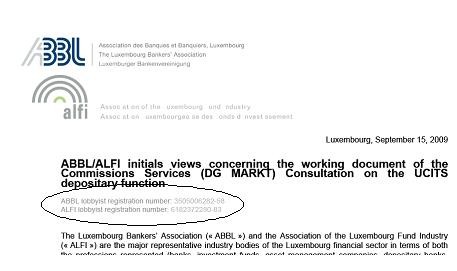
It is amazing to observe that it seems it is the first time the ALFI uses the lobbyist number. I did not see this number on the other position papers (either responses to the CESR or to the European Commission).
In this document ABBL-ALFI do not address the key issues in Luxembourg.
They state that The Madoff affair is the wrong anchor for this discussion. It is premature to reach conclusions about any differences in the protection of investors among Member States until relevant court cases run their courses and the facts – and responsibilities for liability - are established.
I am afraid it is definitely the right anchor.
What do we have in Luxembourg?
Luxembourg Professionals present themselves as lobbyists whose opinion is practically an assent at least in Luxembourg.
I will quote again Rafik Fisher and the regulator.
“The Luxembourg Investment Fund Industry has regularly had a very close and direct say on the evolution of the Luxembourg prudential regulatory environment governing the collective Investment Industry (...) This influence has been exerted directly and indirectly by the lobbying initiatives taken on the level of the different professional associations, be it ALFI or ABBL , but also and more importantly, trough a direct association with the Luxembourg Supervisory Authorities by means of a number of standing committees" (Rafik Fischer, Vice Chairman, ALFI, in 2005, in an article called “Shaping the regulatory environment” that was publish in Fundlook, July 2005)
This is confirmed by the CSSF: "The internal committees assist the CSSF in the analysis of the development of the different financial sector segments, give their advice on any question relating to their activities and participate in the drawing-up and the interpretation of regulations relating to their specific field."
This is beyond an opinion, which would be normal. This is actually an assent.
Changes to the wording of the UCITS directive were decided
I suggest that the European Commission publish a synoptic table of the transposition in every jurisdiction to tighten up the ship and put is the spotlight what is practically the very close and direct say on the evolution of the Luxembourg prudential regulatory environment and the participation in the drawing-up and the interpretation of regulations.
Why some provisions were removed whereas others were added? Such changes are not observed in France or Ireland for example.
The consequence is drifts in Luxembourg
1. UBS acted both as Management Company and Depositary, which is explicitly prohibited by the directive, but not by the Luxembourg law..
2. The safekeeping duty was rephrased in a pragmatic way that is not compatible with the safekeeping duty as stated in the directive
Controls failed (regulator, auditor).
Read my analysis to the European Commission for details
I can conclude by quoting Einstein: We can't solve problems by using the same kind of thinking we used when we created them
17:58 Posted in Luxembourg | Permalink | Comments (0) | Email this
09/25/2009
The words that Claude Kremer, Chairman ALFI, did not say
Claude Kremer, Chairman ALFI, did a very interesting speech where he announced five initiatives.
He did not say anything about the Luxembourg Institute for GLOBAL Financial Integrity.
Two hypotheses:
- LIGFI is definitely dead despite someone is currently playing online with the website by testing layouts and launching a blog in a very professional way
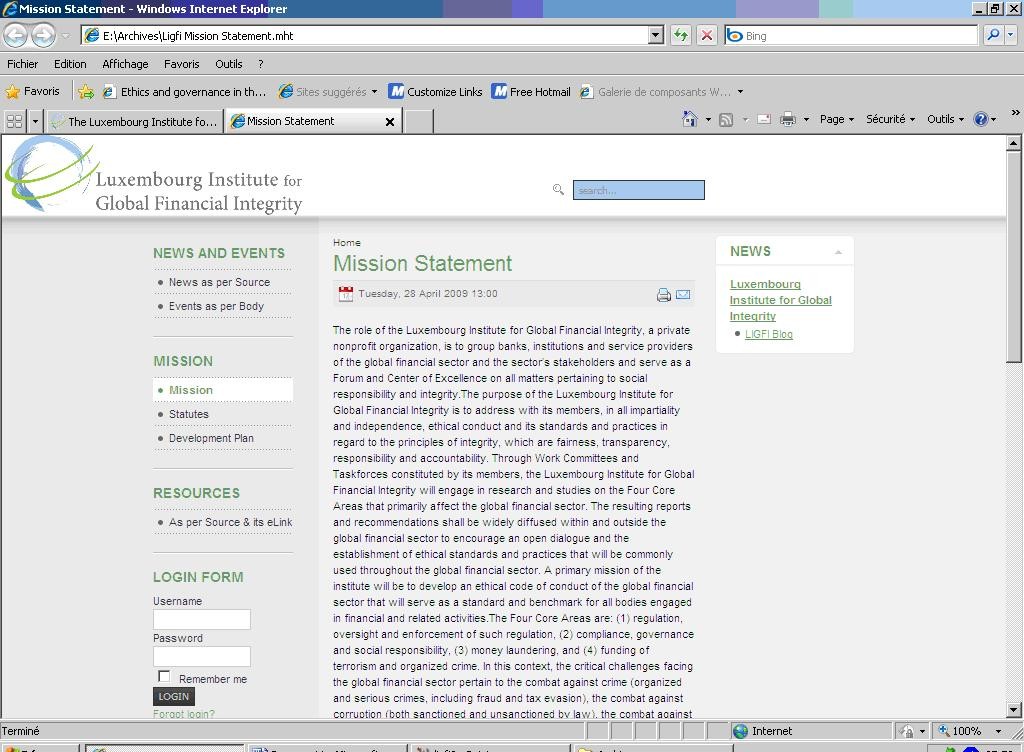
- Professionals do not agree with LIGFI's stated objectives: it is amazing to observe that the LIGFI keywords fairness, responsibility and accountability are not quoted by Claude Kremer. Only transparency is quoted but one can respect transparency in a misleading way by not implementing the other keywords.
07:59 Posted in Luxembourg | Permalink | Comments (0) | Email this
OECD list
Monaco and Switzerland are no longer on the OECD "grey list".
But there is a huge difference : many agreements for Switzerland are with OECD members whereas Monaco signed with many fellow tax havens.
Since the last time the G20 met, in April in London, a few jurisdictions are said to move towards substantial implementation of tax information exchange.
Nothing is actually implemented.
30 countries have come together to build a task force to check the commitments. The head of the group is France's chief offshore tax hunter Francois d'Aubert.
06:00 Posted in General | Permalink | Comments (0) | Email this
09/24/2009
Islamic finance: the Damocles" sword
Everyone in Luxembourg is particularly exited about making money with Islamic Finance.
As I wrote this may be a new cheese for the jurisdiction.
PwC Luxembourg, the audit leader in Luxembourg, has just published a press release about the opportunity.
But there is a critical issue that they probably ignored.
What would do Luxembourg if another jurisdiction (the USA for example) would require the freezing of accounts of persons suspected of terrorism and/or the communication of data relating to their accounts, whereas a terrorist organisation would threaten Luxembourg?
17:21 Posted in Luxembourg | Permalink | Comments (0) | Email this
Global Corruption Report 2009: a misleading report
I went through the Global Corruption Report 2009: Corruption and the Private Sector that was released yesterday by Transparency International.
The press release states that The Global Corruption Report 2009: Corruption and the Private Sector (GCR) shows how corrupt practices constitute a destructive force that undermines fair competition, stifles economic growth and ultimately undercuts a business’s own existence. In the last two years alone, companies have had to pay billions in fines due to corrupt practices. The cost extends to low staff morale and a loss of trust among customers as well as prospective business partners.*
The paragraph "Poverty and corruption is worth commenting.
Whereas the designer of the CPI has just repudiated the methodology and called TI to start anew to educate TI-S yo deliver an acceptable product, TI states that a simple plot reveals a close association between a good performance in the CPI 2008 and income per head (p 395 of the report, 429 of the file).
The graph page 396 (430 of the file) that is based on the CPI is a charade: it seems to say that the richer a juristiction is, the less corruption it has.
.
Luxembourg is the only jurisdiction out of the core graph. So it is in the spotlight.
What else is said in the report about Luxembourg?
Page 135 (169 of the file) : "The OECD Anti-Bribery Convention, for example, requires sanctions for accounting violations related to bribing foreign public offi cials to be ‘effective, proportionate and dissuasive’.A progress report in 2006 identified a lack of clear legal obligations in many countries for auditors and accountants to report suspicions of crimes to the authorities, however. In addition, the report faulted several countries, including Australia, France, Italy and South Korea, for insuffi cient and ineffective sanctions such as low maximum fines and suspended sentences, and countries such as Belgium, Hungary, Luxembourg and Slovakia for weak enforcement".
Page 138 (172 of the file): "By 2008 more than US$1.2 billion had been repatriated from accounts in a number of countries, including Belgium, Liechtenstein, Luxembourg, Switzerland and the United Kingdom (including the crown dependency of Jersey"
I have commented last year blatant inconsistencies when the CPI 2008 was released:
- incoherence with TI Barometer,
- incoherence with GRECO and OECD reports on corruption,
- official business culture: money over ethics,
- conflicts of interest because of the small size
- trend to hush up issues with a press thas is do playing the role of watchdog.
In the recent history,
- Luxembourg is the only EU State member unable to provide data on corruption for the follow up of the OECD Anti-bribery Convention by TI and therefore what is said page 135 (169 of the file) based on a report in 2006 is misleading as it does not take into account the recent observations,
- Luxembourg is the only so called democratic jurisdiction that deny the right for NGOs to to their job of watchdog ,
- Luxembourg did not enforce the criminal liability for legal persons despite an injunction last year (Working Group on Bribery) and this year (Mark Pieth on behalf of the OECD’s Working group on Bribery).
Tax havens are not an issue for Transparency International (it is however notably for the French chapter) even though "tax haven" is quoted 12 times in the report (but not in the press release: neither "tax haven" nor "offshore" are quoted and not in the Executive summary: : neither "tax haven" nor "offshore" are quoted).
A google search of "tax haven" on TI website (site:transparency.org "tax haven") shows 9 results, only 9:
There are 145 résults on TI France website (site:transparence-france.org "paradis fiscaux")
I will quote Richard Murphy:
"Transparency International had a purpose: that purpose has gone, destroyed in no small part by its own small mindedness and the willingness to ignore the risk that sponsorship could be corrupting.
There is a need for a new index: the Tax Justice Network will launch it in October when our Financial Secrecy Index will be made available for the first time. The results look very, very different from those TI have promoted. Corruption is not now an issue in some far away place. It will be an issue very close to where many readers of this blog are. And that’s exactly what TI should have been saying for a long time and failed to do."
As Einstein said, "We can't solve problems by using the same kind of thinking we used when we created them"
06:12 Posted in General | Permalink | Comments (0) | Email this
09/23/2009
Liechtenstein signs tax deal with Monaco
Liechtenstein has just signed an agreement with Monaco to exchange information on fraud and tax evasion based on the OECD tax model.
The jurisdiction has now half of the required agreements (6 out of 12).
Agreements with San marino and Ireland and initialed.
07:29 Posted in Liechtenstein | Permalink | Comments (0) | Email this
09/22/2009
TI CPI Index is dead
Richard Murphy published a letter from Prof. Dr. Johann Graf Lambsdorff to Transparency International.
Who is he?
He is the one that designed the CPI (Corruption Perception Index) in 1995.
What does he state?
He states that he is no longer available for doing the Corruption Perceptions Index.
Why?
By inviting TI to start anew to educate TI-S to deliver an acceptable product, he admits the CPI is no longer an acceptable product.
As Richard said, for three years Tax Justice Network has been a significant critic of Transparency International’s Corruption Perception Index (CPI). The CPI is not even a true index: it is opinion. It is not factually based: it is perception. It is inherently biased as a result. The results cannot be reproduced. Source data cannot be checked.
It is easy to create a good perception when issues are denied or hushep up.
Last year I demonstrated blatant inconcistencies by observing what is going on in Luxembourg whereas the jurisdiction communicates on its good rank (Cf. Government and ABBL)
In the recent history,
- Luxembourg was the only EU State member unable to provide data on corruption for the follow up of the OECD Anti-bribery Convention by TI,
- Luxembourg is the only jurisdiction that deny the right for NGOs to to their job of watchdog,
- Luxembourg did not enforce the criminal liability for legal persons despite an injunction last year (Working Group on Bribery) and this year (Mark Pieth on behalf of the OECD’s Working group on Bribery).
The Tax Justice Network will launch the Financial Secrecy Index in October.
18:11 Posted in General | Permalink | Comments (0) | Email this
09/21/2009
ALFI : new blunder about Madoff (update)
The ALFI’s task force issued a report on Madoff that was presented last Friday. The report states two key initiatives: publication of a code of conduct stamped Alfi, having to list the best practices and recommendations for a better governance as regards investment fund; and the making of a guide of good practices as regards the depositary (see Paperjam and LFF)
Publication of a code of conduct stamped ALFI?
But they used to have one… that was unfortunately withdrawn.
Let’s have a look at their publications.
While ALFI's board of directors and president have changed, the Association's ambitions remain unchanged. We want to anticipate and prepare the future by putting in place training programs for the young professionals of our industry, by educating the investors, by implementing the code of ethics and guidelines for auto-regulation, by working out meaningful statistical data and feasibility studies
A Code of Ethics for the Luxembourg Investment Fund Industry
Not a new idea, but a new emphasis. The will to implement the highest standards for the whole financial sector is of primary importance to the Luxembourg fund industry. In 1998, ALFI issued a code of ethics which set up rules for the various actors in the investment fund industry, whether located in the Grand Duchy or active in Luxembourg from abroad. The main goal of this code of ethics is explicitly to provide additional protection to investors
Revision of ALFI's Ethical Code
The "ethical code" sub-committee of the Legal Committee has initiated a revision of ALFI's ethical code. In fact the Association's current ethical code dates from 1998 and concentrates mainly on questions related to the prevention of money laundering, insider trading offences and investor information. Although no disciplinary proceedings are planned and CSSF has not wished to make this code compulsory for the whole investment fund sector, all institutions or investment funds which have joined ALFI should, in principle, comply with this ethical code. Since the adoption of this regulatory corpus, several circulars relating to deontology have been published by the supervisory authority, in particular circular 2000/15 based on the law transposing the Directive on Investment Services and concerning the rules of conduct applicable to professionals in the financial sector.
Of course this circular is only addressed to financial sector professionals (FSPs), but as ALFI's ethical code covers all those involved in the investment fund industry, the working group has considered it useful to adapt it in accordance with the rules of
conduct issued by CSSF.
The members of the working group have decided to continue to set out in detail the obligations of each category of investment fund professionals and not to adopt the process set out in circular 2000/15, which describes these obligations on an issue by issue basis.
The problem is that I had noticed in 2006, that their code was no longer online.
It was replaced by external codes that were never ever appropriated.
17:30 Posted in Luxembourg | Permalink | Comments (0) | Email this
09/20/2009
Death notice
I have visited yesterday the LIGFI (Luxembourg Institute for Global Financial Integrity) website.
I have noticed that the call for papers for a Conference in Luxembourg about “Ethics, Bank Secrecy & Fiscal Paradise” that was scheduled on 10th & 11th December 2009 is no longer advertised online.
Before

Now

When the LIGFI was launched in May the press release stated the institute would initiate its first open dialogue within the global financial sector and with public and private institutions by organizing a Conference on “Ethics, bank secrecy and fiscal paradise” in Luxembourg on the 10th and 11th of December, 2009.
The purpose of the Luxembourg Institute for Global Financial Integrity is to address with its members, in all impartiality and independence, ethical conduct and its standards and practices in regard to the principles of integrity, which are fairness, transparency, responsibility and accountability (See mission statement)
Unfortunately, in the meantime, a critical report about Luxembourg was victim of censorship under a scandalous pressure on NGOs in a democracy. The report that is perfectible (figures cannot be accurate as data are under banking and professional secrecy) but it addresses key issues. It was withdrawn and repudiated by the Cercle de Cooperation, that ordered the study.
Additionally the press reported that a preliminary report by the Financial Action Task Force FATF is very critical about Luxembourg. Professionals and politicians fustigate the lack of professionalism of the FATF team members and/or the bad faith. They only forget the visible permissiveness in the center:
- No criminal liability of legal persons despite and injunction last year
- 50% of banks never report any declaration of suspicion
- Many companies have a statutory auditor that is neither member of the IRE nor the OEC. There are many statutory auditors from “exotic jurisdictions” that only exist in the Luxembourg Corporate Registration.
- Very little cases before the courts: because of the small size there are many conflicts of interests, many cases of "professional incest". The direct consequence is the small number of crime cases or corruption cases, which are of concern in official reports: “The scarce number of financial crime cases is of concern, particularly for a country that has such a large financial sector.” (Cf. p. 342 of the Narcotic Control Strategy report 2009); “the number of cases coming before the courts appears to be very small”, particularly because of lack of legal and other resources, and the ease with which companies can be established in Luxembourg.” (Cf. page 18 of the GRECO PHASE III Report "Criminalisation of corruption" [theme I] in Luxembourg).
- Ratios that do not comply with international benchmarks (little control and little sanctions compared to other jurisdictions including Monaco)
- Professionals are bold enough to state they influence the regulator. I have no problem for a consultation in the drafting of laws and regulation. But the problem in Luxembourg is that professionals’ opinion is practically an assent.
The list is not exhaustive.
But let’s go back to the LIGFI: as the LIGFI team members live in the bowl they did not know that such body already exist since September 2006: Global Financial Integrity was launched in September 2006 following the publication of Capitalism’s Achilles Heel: Dirty Money and How to Renew the Free-Market System, (John Wiley & Sons 2005), written by Center for International Policy Senior Fellow Raymond Baker. This book demonstrates that the problem of illicit financial flows, and the financial infrastructure supporting it, is enormous. For example, some 70 tax havens and secrecy jurisdictions are in operation across the globe and millions of dummy corporations shield owner’s identities. And the scourge of dirty money is getting worse. Indeed, global corruption has not diminished despite ten years of effort, assets now stashed in tax havens around the globe are estimated at $11.5 trillion, and non-bank cash deposits outside the country of origin are rising. Global Financial Integrity (GFI) promotes national and multilateral policies, safeguards, and agreements aimed at curtailing the cross-border flow of illegal money. In putting forward solutions, facilitating strategic partnerships, and conducting groundbreaking research, GFI is leading the way in efforts to curtail illicit financial flows and enhance global development and security.
This body has just completed a conference on “Increasing Transparency in Global Finance: A Development Imperative”:
The findings are that « The massive flow of illicit money out of developing nations, estimated at some $1 trillion per year, outpaces current levels of foreign aid by a ratio of nearly 10 to 1. Consisting of tax evasion, tax avoidance, and criminal and corrupt funds, this phenomenon is the most damaging economic condition hurting the global poor.
Therefore, the Task Force calls on the G-20 nations to recognize publicly that the flow of illicit money out of poor countries, facilitated by the global shadow financial system, cripples the ability of these countries to work their way out of poverty. Recognizing this linkage is a vital first step in creating the conditions to eradicate poverty in developing countries. The second step is taking action to stop these flows. »
By the way it is exactly the issue that was raised by Rainer Falk’s report.
I with politicians and professionals in Luxembourg had been clever enough to accept the report and take relevant actions to be done as suggested by Egide Thein.
As long as the powers that be in Luxembourg will not recognize that they can no longer misinform the general public by adding further layers of propaganda when independent observers and customers worldwide are waiting for real answers to the legitimate questions raised, they increasingly expose themselves as apparatchiks unable to understand the signs of the time. By remaining in their bowl, they may very well be digging their own graves. Waiting until the storm is over and go back to business-as-usual seems to be the only guideline currently permitted in Luxembourg, where any form of criticism may lead to professional suicide. Is time running out for Luxembourg? If groups like LIGFI are continuously allowed to insult any independent observer’s intelligence, this may very well be the case. You can fool some people some time, but you cannot fool all the people all the time!
14:46 Posted in Luxembourg | Permalink | Comments (0) | Email this
Monaco to be taken off Gurria's tax secrecy 'grey list'
Monaco is to be removed from an OECD "grey list" when it signs a fresh round of international tax agreements on Monday, the Telegraph reported.
As Oxfam, a French NGO, commented, this perspective sounds like a farce. Offam has the same reserves as the Global Forum on Transparency and Exchange of Information.
Tax agreement were signed with jurisdictions that are said to be havens : Andorra, Austria, the Bahamas, Belgium, Liechtenstein, Luxembourg, Qatar, Samoa, San Marino, Saint Kitts.
I am looking forward to reading the OECD press release that should look like the following (adapted from the PR for Luxembourg) :
The Progress Report initially published by the OECD Secretariat on 2 April 2009 in conjunction with the G20 has been updated, and Monaco moves into the category of “Jurisdictions that have substantially implemented the internationally agreed tax standard.”
Having withdrawn its reservation to the OECD standard on exchange of information in March 2009, Monaco has shown rapid progress in updating its treaty network. Further negotiations are under way to update the exchange of information provisions in Monaco’s bilateral treaties.
Welcoming the recent signings, OECD Secretary-General Angel Gurría said: “I commend Monaco for its swift implementation of the OECD standards on exchange of information. In a couple of months, Monaco has turned into reality its commitment to fully cooperate in tax matters. I would like to congratulate Frank Biancheri for his leadership in this process”.
Monaco is thus contributing to strengthen the very important process of transparency around the world, where dozens of other agreements are being signed by different jurisdictions.
Mr. Gurría added that the Monaco government had informed him me that in line with the spirit and purpose of this collective effort they intend to continue the process of negotiating agreements which meet the OECD standard.
Angel Gurria is happy, the OECD is happy, governments in these jurisdictions are happy, bankers are happy....
I must be a fault finder...
09:03 Posted in Monaco | Permalink | Comments (0) | Email this