





11/19/2009
CSSF communicates on Madoff
The Luxembourg regulator yesterday communicated on the Madoff affair once more in a very bad way.
Nothing about the influence of professionals that opened the drift.
But inaccurate statements at the end:
Finally, as regards the three Luxembourg investment companies affected by the Madoff case and currently in judicial liquidation (the "Sicav", cf. CSSF press releases of 15 April 2009 and of 13 May 2009), the CSSF wishes to recall and specify the following points:
- During an authorisation process, the CSSF approves a UCI's incorporation documents, i.e.: the prospectus and the articles of incorporation or the management regulations of the UCI in question. In accordance with the law of 20 December 2002 relating to undertakings for collective investment, a UCI's prospectus has to contain all the necessary information for an investor to reach a properly informed decision on the proposed investment. Internal documents which merely govern the practical terms and conditions between professionals (such as operating memoranda) have to comply with the contents of the approved and published prospectus and cannot deviate therefrom. These internal documents are not submitted to the CSSF.
- The documents submitted to the CSSF in the framework of the authorisation procedure for each of the three Sicav,1 on the basis of which they were registered on the official list of UCIs, included no reference neither to the identity of BMIS nor, more importantly, to the multiplicity of functions carried on de facto by one entity. Between the launch of the various Sicav and the breakout of the Madoff affair in December 2008, the CSSF was never informed in a transparent manner, by the professionals involved, of the structure actually set in place nor of the role played in practice by BMIS at different levels of this structure.
Let's have a look on the original prospectus page 7:
(  Click to enlarge)
Can CSSF seriously state it was not aware of the multiplicity of functions carried on de facto by one entity as it was not de facto but actually de jure?
Who was Portfolio Manager, Custodian and main Paying agent, Distributor ? The same entity located at the same address.
Once more stakeholders, and especially investors, are considered as idiots in this secrecy jurisdiction that is unable to make amend.
06:09 Posted in Luxembourg | Permalink | Comments (0)
TI implicitly admits in the FAQs that the CPI
I quoted yesterday Dr. Johann Graf Lambsdorff, creator of the Corruption Perceptions Index. He said in an email to the Transparency International network: "It is you, the movement, that will have to start anew to educate TI-S to deliver an acceptable product."
TI published the CPI but with a new paragraph in the FAQs that did not exist the previous years. This paragraph confirms implicitly that the CPI is of no avail and therefore is not an acceptable product.
To answer the question "Is the country with the lowest score the world's most corrupt country?", TI states in 2009 that
No. The country with the lowest score is the one where corruption is perceived to be greatest among those included in the list. There are more than 200 sovereign nations in the world, and the latest CPI 2008 ranks 180 of them. The CPI provides no information about countries that are not included.
Example: What is implied by Somalia’s ranking in the CPI 2008?
Corruption in Somalia has been perceived to be the highest in the CPI 2008. This does not, however, indicate that Somalia is the ‘world’s most corrupt country’ or that Somalians are the ‘most corrupt people’. While corruption is indeed one of the most formidable challenges to good governance, development and poverty reduction in Somalia, the vast majority of the people are victims of corruption. Corruption by powerful individuals, and failure of leaders and institutions to control or prevent corruption, does not imply that a country or its people are most corrupt.
In the same light, New Zealand – whose perceived public sector corruption is the lowest of the 180 countries surveyed – is not necessarily the ‘world’s least corrupt country’ – and New Zealanders are not in turn immune to corruption. Though its institutional and governance framework have translated into what is perceived to be a success, with limited corruption, New Zealand – like any other state – remains susceptible to corruption.
(Click to enlarge)
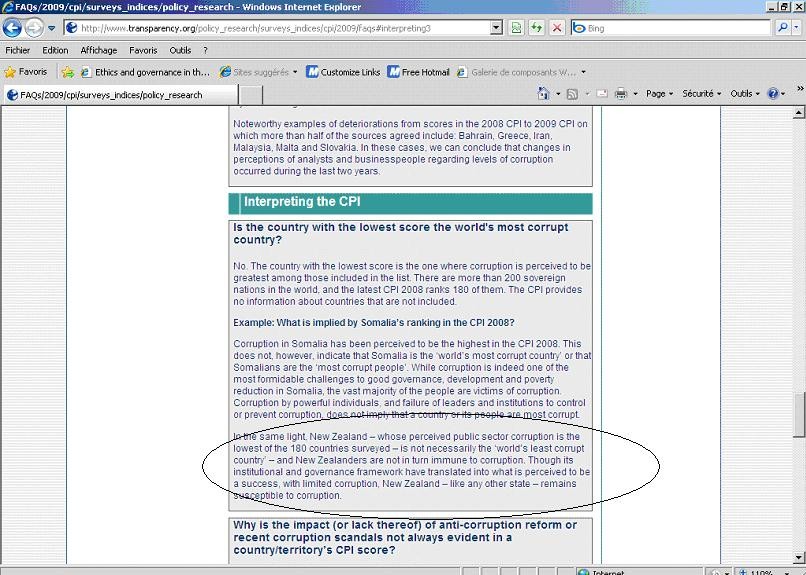
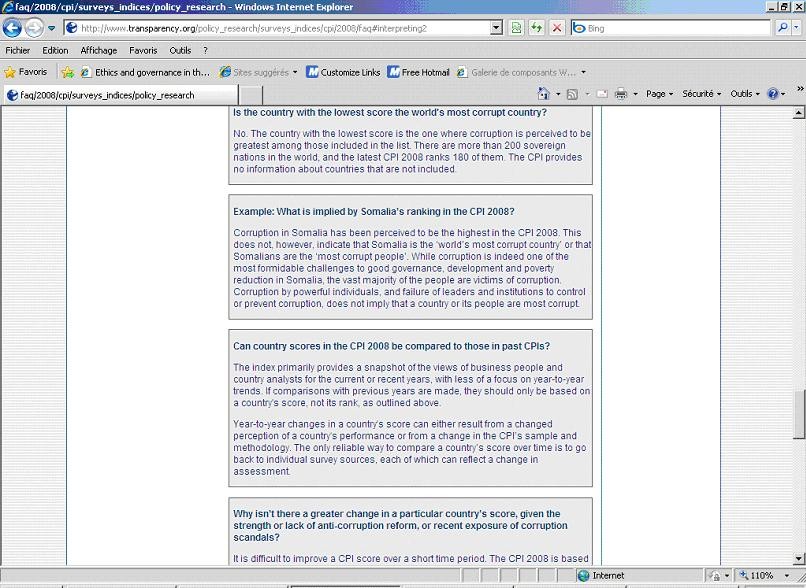

The Corruption Perception Index is not actually an acceptable product, but TI lays emphasis on the possible misinterpretation like it was the case in Luxembourg: "Gute Noten für das Großherzogtum" (Wort), "Le Luxembourg douzième du peloton des incoruptibles" (L'Essentiel).
By the way, Luxembourg, the only democracy were NGOs were attacked, was ranked N° 2 by TJN for its financial secrecy and however TI states in the press release this year that "Financial secrecy jurisdictions, linked to many countries that top the CPI, severely undermine efforts to tackle corruption and recover stolen assets. Corrupt money must not find safe haven. It is time to put an end to excuses,” said Labelle. “The OECD’s work in this area is welcome, but there must be more bilateral treaties on information exchange to fully end the secrecy regime. At the same time, companies must cease operating in renegade financial centres"
05:39 Posted in General | Permalink | Comments (0)