





11/01/2009
Madoff: a challenge for LIGFI
As LIGFI is calling to recruit member, I state again that I do not believe that LIGFI is a sincere initiative.
There are many red flags that it is actually an economic intelligence operation born by both Luxembourg professionals in or close to the financial sector and the government of Luxembourg:
1. Most LIGFI founders are Luxembourg people, live and work in Luxembourg, in or close to the financial sector.
2. LIGFI states it is engaged in recruiting members and partners within and outside the global financial sector, but it only explicitly calls for banks, other financial services and service providers to the financial sector to join the association (in bold)
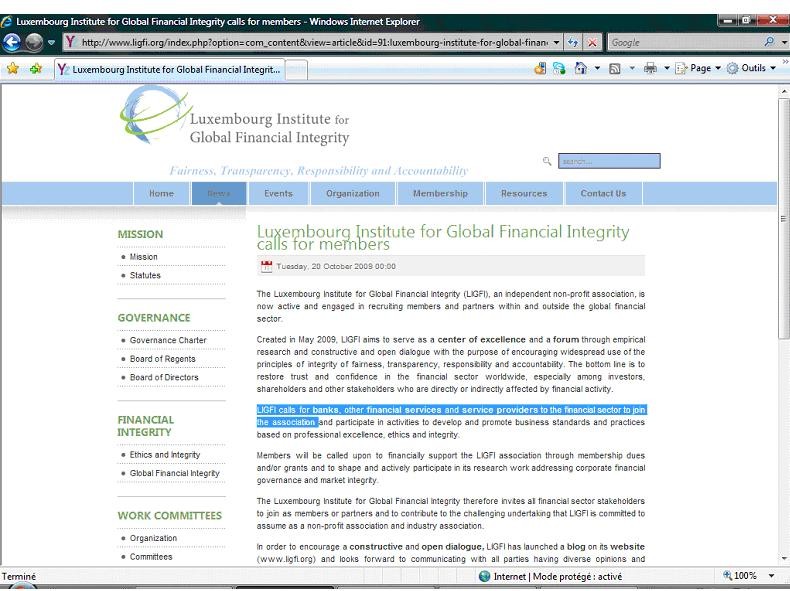
3. Academe have ridiculous voting rights whereas those who have the money (financial institutions) have the most rights.
Statutes, Art. 28. Charter members have eight voting rights each; public and private institutions have four voting rights each; financial sector and professional services have two voting rights each, and academe have one voting right each
4. Critics and those who are not right-minded are excluded or will be excluded and loose their money
Statutes, Art. 10. The board of directors has final decision making power over all written membership requests. A denied application need not be substantiated.
Statutes, Art. 11. Any member who jeopardizes the interests of the a.s.b.l. or who fails to meet his due obligations may be excluded.
Statutes, Art. 12. The exclusion of a member may only be decided under the cases prescribed by the articles of incorporation by the general meeting under a two third majority.
The member resigning or being excluded retains no right on the assets of the a.s.b.l. and he cannot claim his subscription fee back. Any member shall be deemed to have resigned if he fails to pay his membership dues within three months of the date of payment of such dues.
5. LIGFI ignores powerhouses in the debate on financial integrity
GFIP and TJN are ignored despite they are leading organisations in the debate. They have just published the Financial Secrecy Index.
The Grand Duchy of Luxembourg ranks number two on the index. While not such a big player in private banking as Switzerland, Luxembourg hosts a massive hedge fund activity which attracts investors from around the world. TJN recently visited the Grand Duchy and met various bankers. Like their counterparts in other secrecy jurisdictions, they like to portray themselves as guardians of privacy. What they do not say is that it is the privacy of rich élites that they care about – that is, élites in other countries who want to evade paying their taxes.
As I said there is knowingly a lack of transparency in Luxembourg, where professionals have an abnormal influence on the regulator and the government, which was confirmed by a recent ALFI brochure: “Your bridge between Europe and China: Luxembourg” that was online last week.
This brochure states page 2: "Shape regulation. An up-to-date, innovative legal and fiscal environment is critical to defend and improve Luxembourg’s competitive position as a centre for the domiciliation, administration and distribution of investment funds. Strong relationships with regulatory authorities, the government and the legislative body enable ALFI to make an effective contribution to decision-making through relevant input for changes to the regulatory framework, implementation of European directives and regulation of new products or services." (Source: Alfi)
I would paraphrase what this means for LIGFI:
Shape ethics. An up-to-date, innovative ethical framework is critical to defend and improve Luxembourg’s competitive position as a financial centre. Strong relationships with LIGFI enable ABBL and ALFI to make an effective contribution to decision-making through relevant input for changes to the ethical framework, implementation of directives and regulation of new products or services.
However I want to give a chance to LIGFI to corroborate it is a sincere operation when it states that the principles of integrity governing the activities and behavior of the Luxembourg Institute for Global Financial Integrity are those of fairness, transparency, responsibility and accountability.
As I demonstrated the UCITS directive was definitely not faithfully transposed in Luxembourg law and regulation, which opened the drift with Madoff.
Why it was not faithfully transposed? Because of the ALFI effective contribution to decision-making through relevant input for changes to the regulatory framework, implementation of European directives and regulation. Quod Erat Demonstrandum, thanks to ALFI.
A recent significant change in the wording gives up the so-called “faithful transposition”.:
“Our opinion is that Luxembourg transposed the directive as it was needed”, Claude Kremer, Chairma ALFI said in September. He is a smart lawyer. He perfectly knows the meaning of words. Before, the communication was that Luxembourg transposed the directive “failthfully”. Claude Kremer said “as it was needed”, which is not the same meaning as “faithfully” and complies with the truth: the transposition was done as it was suggested by ALFI in its effective contribution to decision-making through relevant input for changes to the regulatory framework, implementation of European directives and regulation.
My challenge for LIGFI:
LIGFI should recommend on the model of Luxakpha (http://www.luxalphainliquidation.lu) a special database available online for free that would gather every document relating to every fund and sub-fund that were impacted directly or indirectly by the case linked to Bernard L. Madoff as identified by CSSF, and especially prospectuses and annual reports including the 2008 or 2009 report disclosing losses based on having invested in Madoff.
There is already a good database in the jurisdiction (www.finesti.com) : this is a free service for private investors that have a limited access whereas professionals have a chargeable service with access to the full range of data and documents on the Finesti site. Unfortunately many documents relating to undertakings for collective investment (UCIs), respectively UCI sub-funds of Luxembourg law which were impacted directly or indirectly by the case linked to Bernard L. Madoff, are not available.
I wonder why nobody in Luxembourg already suggested this idea (What was LIGFI contribution the last six months?) for stakeholders.
Maybe because Luxembourg is a secrecy jurisdiction, where the collective business culture is not compatible with the principles of fairness, transparency, responsibility and accountability.
06:39 Posted in Luxembourg | Permalink | Comments (0)
The results of the 2009 Financial Secrecy Index
TJN has just published the Financial Secrecy Index i.e. secrecy jurisdictions that they have ranked according to both their lack of transparency and their scale of cross-border financial activity.
Number 5 is the City of London in the United Kingdom, the world's largest financial centre with a Financial Secrecy Index Value of 347.79.
Number 4 is the Cayman Islands with a Financial Secrecy Index Value of 403.48.
Number 3 is Switzerland with a Financial Secrecy Index Value of 513.40.
Number 2 is the Grand Duchy of Luxembourg with a Financial Secrecy Index Value of 1127.02.
Number 1 is Delaware in the United States of America with a Financial Secrecy Index Value of 1503.80.
The average for the Financial Secrecy Index Value is 79.04 .
It is not a surprise for me to see Luxembourg with such score. I have been warning for years decision-makers in the jurisdiction to correct dysfunctions, lax behaviours. They did not that they thought that being a long-standing member of European Union, of the the Financial Action Task Force (FATF), of OECD... would provide both impunity and intouchability.
The censorship of Rainer Falk's report and the launch of LIGFI corroborate that the jurisdiction does not call itself into question.
I guess that as usual they will comment TJN's index by saying something like: Dubious index on financial secrecy: the ABBL responds. The ABBL deplores the fact that, behind a pseudo-scientific façade, this document calls into question thereputation and standards of the Luxembourg Financial Centre in general and of its members in particular. Luxembourg is a long-standing member of the Financial Action Task Force (FATF). Its efforts to preventmoney laundering have recently been highlighted by international organisations, such as the InternationalMonetary Fund (IMF). The ABBL has serious doubts about the methods used to draw up the study. The conclusions do not reflect a serious scientific approach. And blablabla.
TJN's work demonstrates to what extent OECD's work that is influenced by jurisdictions and political games is not relevant.
05:42 Posted in General | Permalink | Comments (0)